
Let’s be honest: many of your people probably know more of a second language than they dare to use. They’re sitting on hard-won vocabulary and grammar, but when it comes time to actually speak up in a meeting or on the shop floor, they clam up. Not because they’re lazy or unmotivated or don’t want to “lean in.” For many of them, it’s because they’re afraid of sounding wrong. Enter AI language learninga.
Your employees’ hesitation isn’t just a personal hurdle. It’s a hidden business problem. Every unspoken idea, every botched hand-off, every moment of “I’ll just email later” chips away at productivity, safety, and morale. And yet most corporate language training programs never address it. If you’ve implemented a language program in your organization, only to watch adoption numbers sink, or if you’re considering one but are concerned about whether your employees will use it, boosting speaking confidence may be the secret sauce you need to make your language learning program a success.
It’s time to stop treating speaking anxiety as a side issue and start seeing it for what it is: one of the top barriers to language learning success. The good news? With the right mix of culture, practice, and new tools like AI conversation partners, you can help employees move from silence to confidence and watch team performance soar.
Table of Contents
- 1. The Real Obstacle: Speaking Anxiety, Not Knowledge
- 2. Why Language Anxiety Is a Business Problem
- 3. AI Language Learning: Breaking the Silence Safely
- 4. What Companies Can Do Beyond Just Offering Apps
- 5. The Way to Overcome the Hidden Barriers
- From Anxiety to Action
1. The Real Obstacle: Speaking Anxiety, Not Knowledge
Many organizations focus their language programs on grammar drills and vocabulary tests. But this overlooks speaking anxiety as a key obstacle in language learning. Research shows that anxiety about communicating in a second language negatively impacts innovative performance. When employees are worried about sounding wrong, their ability to contribute new ideas or engage confidently takes a hit. However, top management support, such as expressing psychological safety and openness, can mitigate these effects significantly.
Inclusive leadership also plays a pivotal role. In studies involving multicultural teams, speaking in a non-native language was strongly associated with job anxiety. Yet, when team leaders practiced inclusive language management, such as encouraging participation regardless of language proficiency, anxiety dropped, even more so than improvements in language skills alone.
Even capable employees may stay silent…and that silence costs your business.
2. Why Language Anxiety Is a Business Problem
When employees are too anxious to speak up in a second language, the effects ripple far beyond the individual. What starts as a moment of hesitation can snowball into missed ideas, weaker collaboration, and costly mistakes. Teams lose energy, morale erodes, and some of your most capable people stay invisible simply because they’re afraid of getting a word wrong. In other words, speaking anxiety is a hidden drag on innovation, engagement, productivity, and talent utilization. Some of the negative effects of language anxiety include:
- Stifled Innovation: Fear suppresses idea-sharing, collaboration, and initiative-taking, especially in diverse, multilingual teams.
- Lower Engagement & Morale: Avoiding conversations erodes belonging. It chokes team cohesion.
- Lost Productivity: Misunderstandings lead to rework, mistakes, and delays.
- Underutilized Talent: You may have star performers who hide in the wings because speaking holds them back.
Helping employees break through their hesitation is a strategic move with multiple benefits.
3. AI Language Learning: Breaking the Silence Safely
Enter AI-powered language practice, the quiet confidence booster. While an AI language learning app can give workers a quick solution to an immediate language hitch, it can’t build the kind of knowledge and confidence that underpins real communication.
Why an AI Conversation Partner Helps:
- Judgment-Free Practice: AI conversation partners accept stumbles, offering a safe, pressure-free space. No giggle or thoughtless correction that makes the speaker feel foolish.
- Instant, Personalized Feedback: Learners get corrective guidance immediately with no embarrassment and no waiting.
- Scalability: Every employee gets access simultaneously, no scheduling, no logistics.
- Flexible, Just-in-Time Learning: Practice anytime, anywhere.
These strengths make AI tools like Babbel Speak particularly suited to tackling speaking anxiety head-on while building the kind of competency that builds employee confidence and team cohesiveness.
AI as a Confidence Accelerator
Research into generative AI for workplace learning, including conversational agent use, shows that employees welcomed such tools and experienced greater self-directed motivation. Moreover, a field study of generative AI assistants reported a 15% average boost in worker productivity, especially among international, non-native English speakers, who gained both speed and fluency.
In language learning specifically, platforms that use AI for conversation simulation help learners feel more comfortable in real-world speaking situations, bridging the gap between knowing and speaking.
4. What Companies Can Do Beyond Just Offering Apps
The first step for any organization serious about breaking the speaking-anxiety barrier is to build a culture where mistakes are not punished but normalized. When managers model patience and curiosity, praising “good tries” instead of perfect delivery, they signal to employees that communication attempts are valued over flawless grammar. That leadership tone does more to lower anxiety than any formal language policy ever could. A culture that promotes lifelong learning and curiosity goes a long way to reducing learning anxiety.
Forward-thinking companies weave micro-practice moments into the rhythm of work. It might be a daily AI-powered conversation prompt, a “speak first” ritual at the start of meetings, or informal peer-to-peer practice breaks. These small, frequent interactions do more to build confidence than a quarterly workshop.
Technology plays a powerful supporting role here, but only if it’s layered thoughtfully into a wider ecosystem. AI language learning tools should supplement, not supplant, human instruction. They’re at their best when used as low-stakes rehearsal before a real client call, or as on-demand practice between live coaching sessions. Pairing AI practice with group discussions, coaching, or peer support creates a continuous feedback loop that feels safe and progressive.
Equally important is how you measure success. Completion rates and test scores tell only part of the story; the more meaningful metrics are confidence indicators. How many conversation attempts are employees making? How does their self-reported comfort level change after a month of practice? Are they volunteering more to speak in meetings or presentations? Tracking these signals reveals whether your program is actually shifting behavior, not just ticking boxes.
Finally, think carefully about your rollout. Introduce AI practice tools as a private confidence builder, not as another test to pass. Communicate clearly, encourage employees to “try, fail, improve,” and celebrate small wins. Announcing in a meeting, “This week, 67% of our staff practiced speaking in Spanish for the first time” emphasizes the benefits of trying and helps to keep momentum high. A thoughtful launch plan can make the difference between a tool that intimidates and one that liberates.
5. The Way to Overcome the Hidden Barriers

When it came time to incorporate AI into the Babbel for Business suite of solutions, we wanted to think carefully and retain our human-first ethos. We were deliberate about choosing where AI could best support learners. Enter Babbel Speak, engineered exclusively for this purpose. It’s an AI-driven conversation partner that gives employees a judgment-free environment to rehearse real-life scenarios in their own words. By blending freeform dialogue with calming visual cues and welcome scenarios, it helps learners ease into speaking without the fear of being graded.
Because Babbel Speak is designed as a bridge, sitting between structured lessons and live interactions, it complements, rather than replaces, traditional learning. Employees can move seamlessly from app-based learning to AI-powered practice to live coaching, building confidence at every step. For companies, this means a scalable way to help staff practice fearlessly and show up in real workplace conversations ready to speak, not just understand.
From Anxiety to Action
The real barrier to language learning success? It isn’t grammar. It’s fear. But fear is not fixed. With the right culture, tools, and encouragement, employees can overcome it and discover the confidence to communicate their ideas and potential.
By integrating AI language learning tools like Babbel Speak into a thoughtful, psychologically safe ecosystem, businesses enable their teams to transition from watchers to speakers and from hesitant to high-performing.
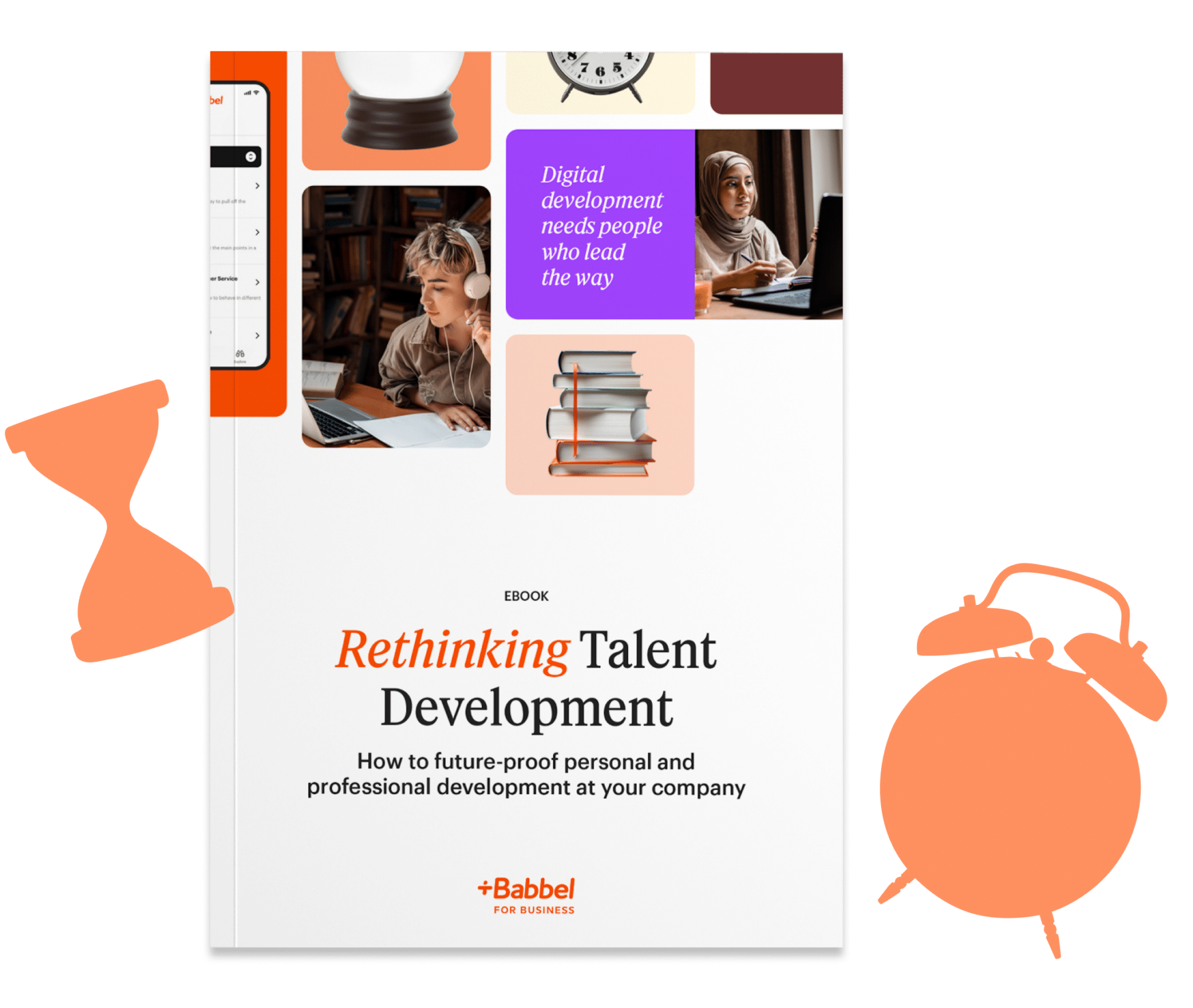
How to attract and retain talent?
To survive in today’s competitive economic market, companies need to have a plan to attract and retain top talent.
Take a fresh look at your talent development efforts and retain talent across your business with this ebook.